Security Level
Scenario Description
Security levels are used to control the visibility permissions of items.
Main Features
Security Level List
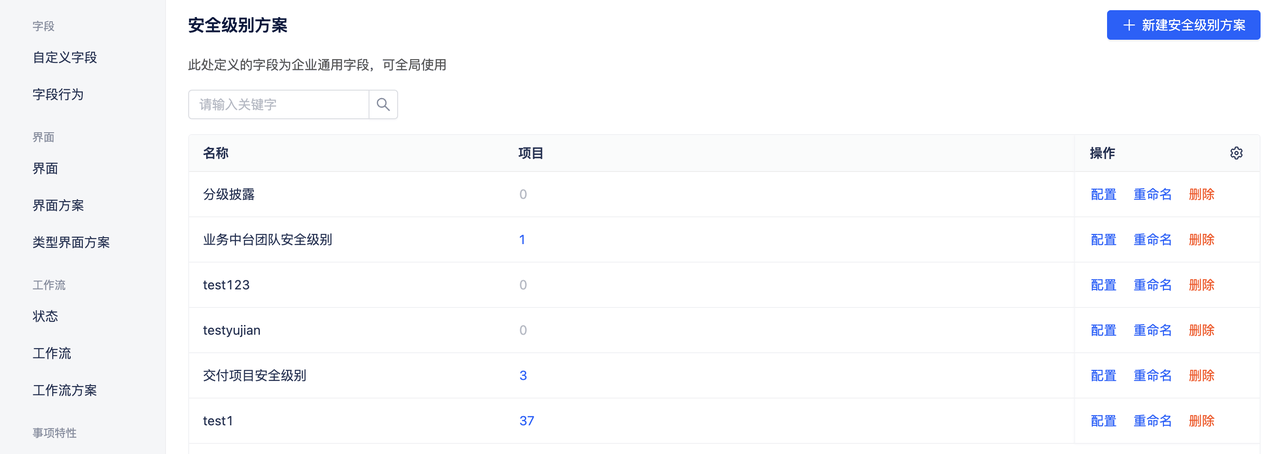
- Entry: Team Settings -- Security Level Scheme
- List Display: Template name, project count (number of projects the security level is applied to), operations (configure, delete, rename)
- Name: Fixed name display length, excess shown as "...", full name displayed on mouse hover
- Project Count: Shows how many projects use this security level field. Click the number to open a floating box showing specific project names. Click the name to enter Project Settings --- Item Security Level. Search: Fuzzy search for project names
- Operations: Configure: Click [Configure] to enter the security level configuration page; Rename: Click to pop up name edit box; Delete: Delete button only available when applied project count is 0
- Sorted by creation time in descending order
Security Level Configuration
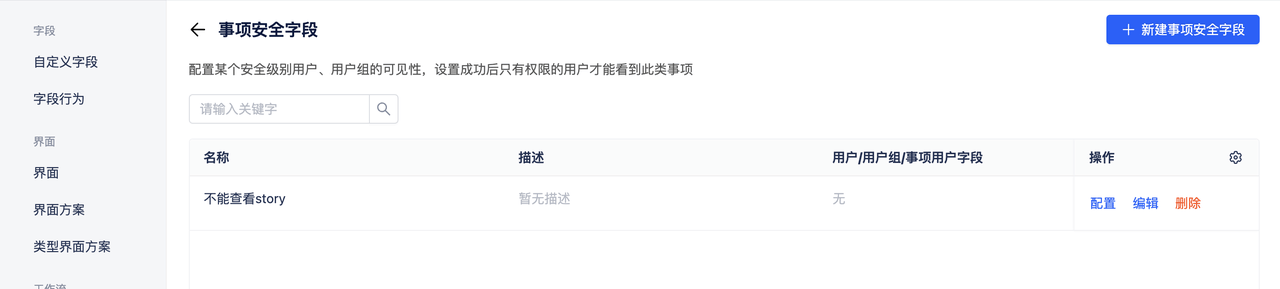
Description:
- Click the corresponding security level to enter the configuration page
- Click [Add Item Security] to pop up the above dialog, enter name and description. Name: 1-50 characters, cannot be duplicated, required, supports Chinese, letters, special characters, etc. Description: Optional, 0-256 character limit
- Click [Settings] to enter configuration page
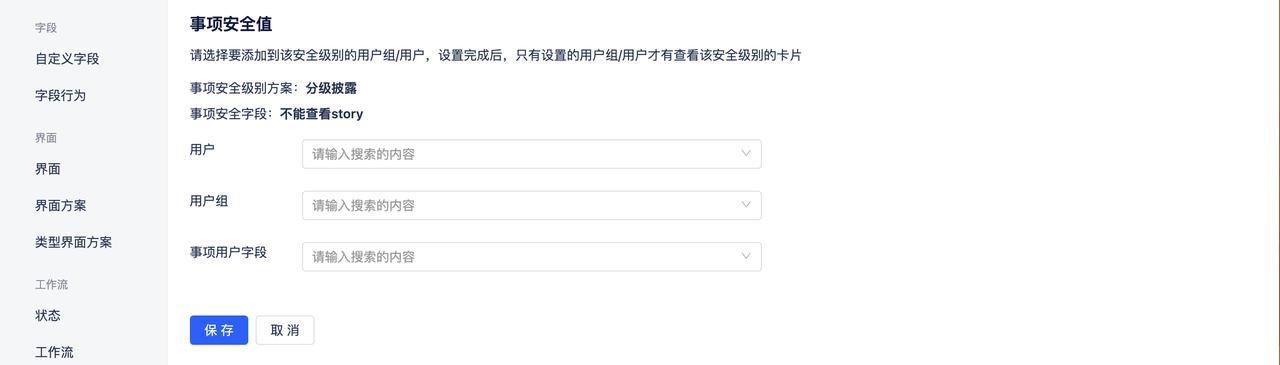 Description:
The configuration page is divided into 3 tabs: Set User Groups, Set Users, Set Item User Fields
- User Groups: Read all user groups in the enterprise
- Users: Read users with [Active] status in the enterprise
- Item Personnel Fields: Item creator, item assignee, and custom user fields
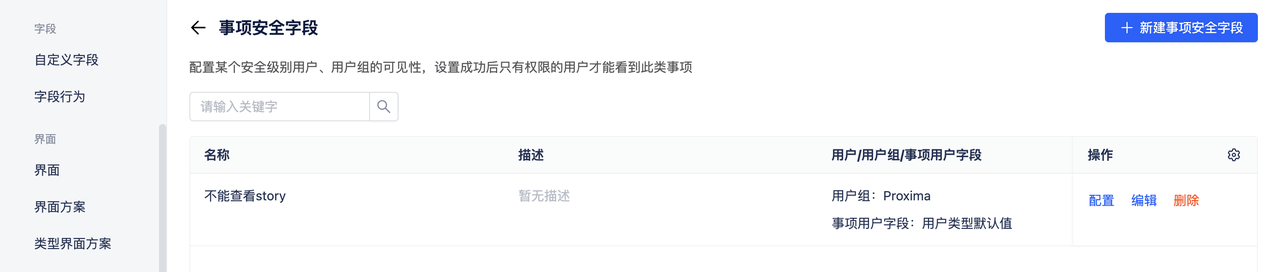
After successful configuration, display as shown below
Security Level Application
- Security level schemes combine with other schemes to form [Space Configuration Scheme] applied to spaces. Security level scheme is optional. If no security level scheme is selected, you need to add [Security Level Scheme] in Space Settings -- Space Configuration
- Then apply the security level field to the interface in interface configuration. After applying to the interface, the security level of this space takes effect according to the security level scheme
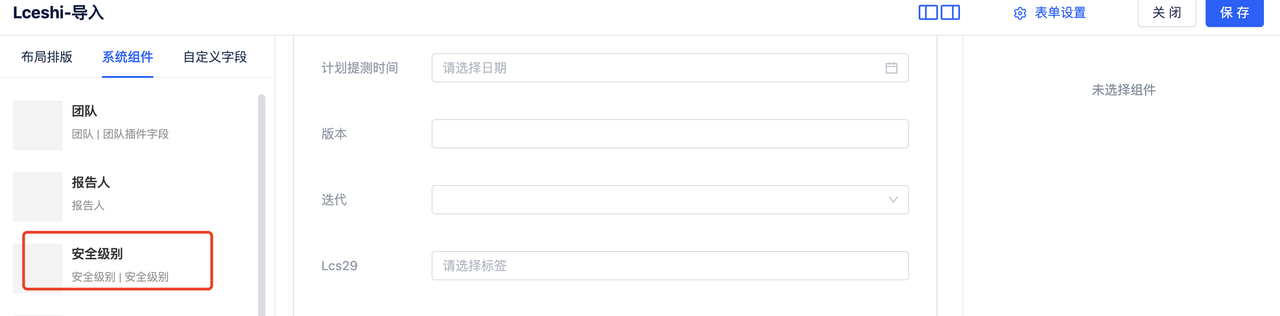
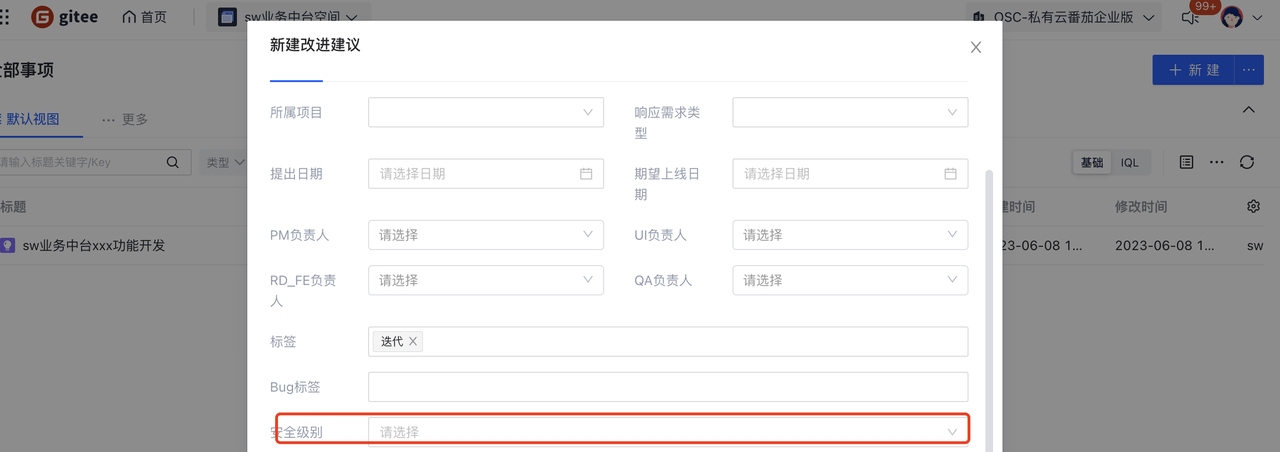
- When creating items, the security level selection range can only choose values the user has permission for. After setting, only authorized users can see the item
Rules
- If an item has selected a security level field but the field value is empty, all members in the project can see it
- If an item has not selected a security level field, all members in the project can see it
- If an item is configured with security levels 1 and 2, and level 1 is configured so only user A can see it, then A can only see level 1 in the security level dropdown when creating new items. Same logic applies to user groups
- If an item is configured with security levels 1 and 2, and both 1 and 2 are configured for item creator visibility, then the logged-in user can see the item only when they are the creator of that item and the item's security level is 1 or 2. Same logic applies to assignees
- For parent and child item rules: if a user can see the parent but not the child item, only the parent is shown in hierarchical display and only accessible items are shown in list display. If a user can see the child but not the parent, nothing is displayed
- In queries and searches, users can only view data they have permission to access